

The Ultimate Guide to Choosing the Right Toothpaste
Choosing toothpaste shouldn’t feel overwhelming. This simple guide breaks down fluoride, hydroxyapatite, whitening pastes and SLS free options so you can choose the right toothpaste with confidence.
Choosing a toothpaste should be simple.
But walk down any supermarket aisle and it can suddenly feel like you need a degree in chemistry to understand what you are looking at.
"Whitening." "Enamel repair." "Nature identical minerals." "Ultra micro nano crystal technology."
The claims can be confusing, even when you do understand the science.
This guide breaks down the key toothpaste ingredients, what they actually do, and how to choose the best toothpaste for your needs in clear, normal human language.
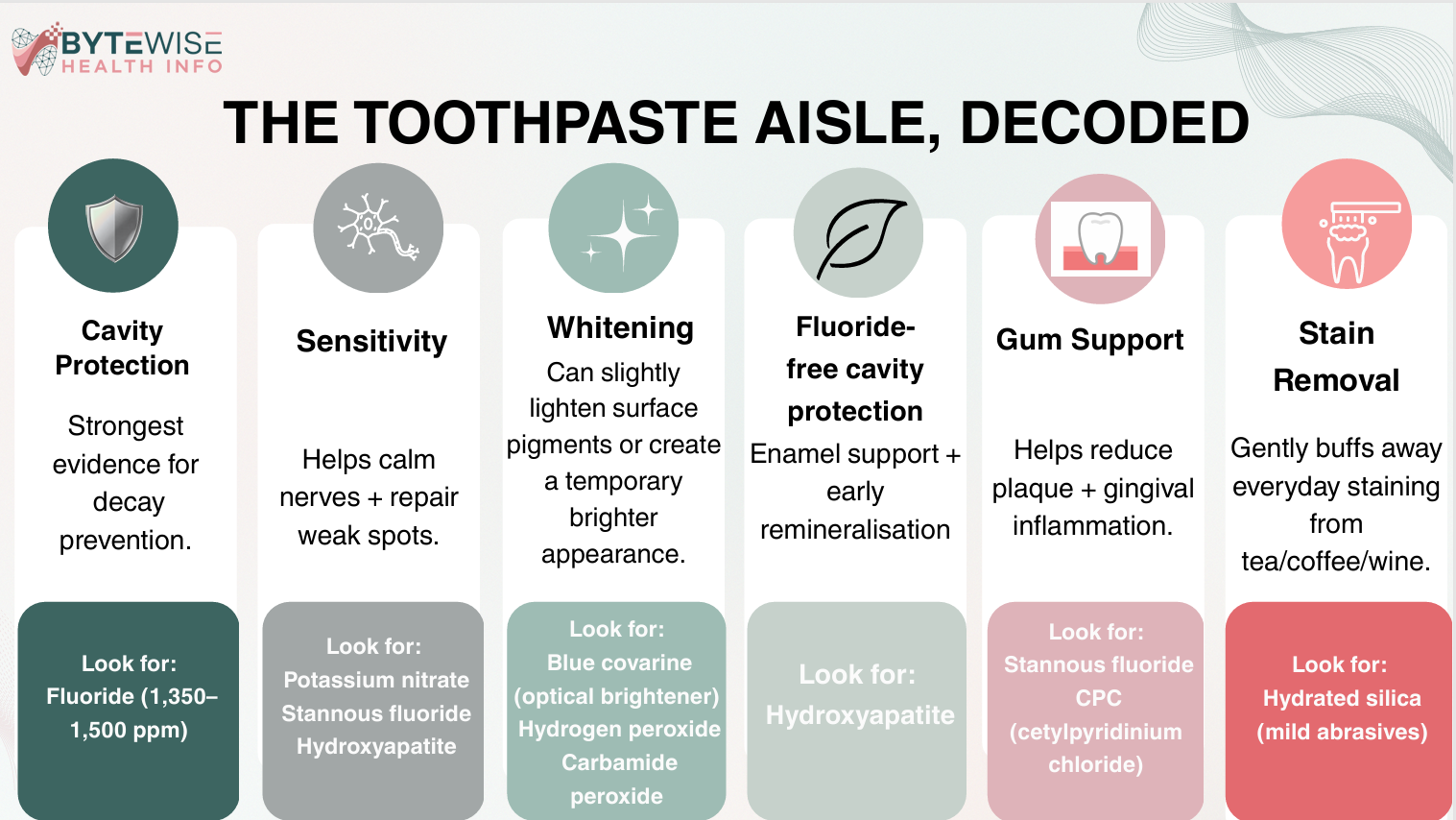
The toothpaste aisle, decoded. A simple guide to ingredients and what they do.
How to Understand a Toothpaste Label
Fluoride – the essential one
Fluoride is the ingredient with the strongest, longest standing evidence for preventing tooth decay.
It helps to:
strengthen enamel
slow early decay
make teeth more resilient
This is why fluoride toothpaste is recommended for most adults.
You will usually see fluoride shown as ppm (parts per million). This simply describes the concentration of fluoride in the toothpaste.
Types of fluoride you will see
Most toothpastes use one of two main forms:
Sodium fluoride
Stannous fluoride
Both protect against decay.
Stannous fluoride also offers added benefits for gum health and sensitivity relief, which can make it a good choice for people with bleeding gums or sensitive teeth.
For everyday use, adults should choose toothpaste with 1,350 to 1,500 ppm fluoride.
How Much Fluoride Do Children Need?
For children, the recommended fluoride level and the amount of toothpaste used depends on their age:
Under 3 years: a smear of toothpaste with at least 1,000 ppm fluoride
Ages 3 to 6: a pea sized amount of 1,000 to 1,500 ppm
Age 7 and above: usually fine to use adult strength toothpaste (1,350 to 1,500 ppm)
Children often prefer milder flavours. It is absolutely fine to stay with a child friendly toothpaste as long as the fluoride level is appropriate.
When my three were younger, we often had several different tubes lined up on the bathroom shelf. One for each age and stage.
If your bathroom looks similar, you are not doing anything wrong. It is just a phase, and once everyone moves onto adult toothpaste, things get slightly simpler.
A note on how much toothpaste to use
Young children swallow toothpaste more often, and their adult teeth are still developing under the gums.
Using the right amount helps prevent fluorosis (a harmless but sometimes mottled appearance on enamel).
Under 3 years: a smear
Ages 3 to 6: a pea sized amount
A pea sized amount also makes it safe for children aged 3 and over to use adult strength toothpaste if needed, especially if they are more prone to decay.
If a child is at higher risk of tooth decay, your dentist or hygienist may recommend stronger fluoride toothpaste sooner, or prescribe a paste that is not available over the counter.
Hydroxyapatite toothpaste: what it does (and what to look for)
Hydroxyapatite is the mineral your enamel is made from, which is why it’s showing up in toothpaste. It’s a biomimetic (“nature-mimicking”) ingredient that supports enamel—often chosen by people who want a fluoride-free toothpaste. It isn’t a like-for-like replacement for fluoride, but it has its own role.
How hydroxyapatite works
Hydroxyapatite can help to:
“fill in” tiny surface defects on the enamel
reduce sensitivity
smooth the tooth surface
support remineralisation
For people looking for fluoride-free toothpaste, hydroxyapatite is one of the few ingredients with emerging evidence behind it.
Some toothpastes even combine fluoride and hydroxyapatite for a dual approach.
There is no standardised “ideal concentration” for hydroxyapatite yet. Brands are not always required to list the percentage. Some formulas use around 10 per cent, others vary.
Instead of focusing on a number, focus on:
choosing a reputable brand
checking that hydroxyapatite appears reasonably high on the ingredient list
Top tip:
If you spot words like “biomimetic”, “microcrystalline” or “nature identical mineral” on the packaging, it is often a marketing-friendly way of describing hydroxyapatite.
A Quick Note on Ingredient Sensitivities (Including During Chemotherapy)
Some people react to certain toothpaste ingredients.
Not with tooth sensitivity, but with irritation of the mouth tissues.
One of the most common triggers is SLS (sodium lauryl sulphate), a foaming agent found in many toothpastes.
SLS is considered safe, but for some people it can:
trigger mouth ulcers
cause a stinging or burning feeling
irritate the cheeks or lips
make the mouth feel drier
People undergoing chemotherapy can be especially sensitive to foaming agents and stronger flavours, because treatment often leaves the mouth dry, delicate, or more prone to ulceration.
If you notice toothpaste making your mouth feel sore, or if you are going through chemotherapy, switching to an SLS free, mild flavour toothpaste can make brushing far more comfortable.
Most brands clearly label “SLS free” on the front of the packaging.
If not, a quick check of the ingredient list on the back will tell you. You are looking for “Sodium Lauryl Sulphate” (or “Sodium Lauryl Sulfate” with the American spelling).
If it is not listed, the toothpaste is generally SLS free.
SLS free toothpastes clean just as effectively. They simply foam less.
Whitening Toothpaste – What Actually Works?
You have probably seen the promises:
“Instant whitening.”
“Five shades brighter.”
Some claims are hopeful. Some are pure sparkle. So what do whitening toothpastes actually do?
Mild abrasives – the stain polishers
Most whitening toothpastes use ingredients like hydrated silica to gently polish away surface stains from coffee, tea and red wine.
These are great for lifting daily staining, but they will not change the natural colour of your teeth.
Chemical lighteners – the gentle lifters
Some formulas contain low dose hydrogen peroxide or carbamide peroxide.
These can brighten the surface slightly, but they do not reach deeper pigments in the same way professional whitening gels do.
Optical brighteners – the illusionists
Some pastes use blue pigments (such as blue covarine) that temporarily change the way light reflects off enamel, giving an instant but short lived brightness boost.
What I see in practice
In day to day practice, the best “everyday brightening” results usually come from:
a mildly abrasive whitening toothpaste
used with an electric toothbrush
It will not transform your tooth shade, but it can noticeably lift surface staining.
A note on tooth sensitivity
Whitening toothpastes can increase tooth sensitivity, especially if they are more abrasive.
If your teeth tend to twinge:
try a whitening plus sensitivity toothpaste, or
alternate your whitening paste with a regular fluoride toothpaste
The Bottom Line – How to Choose the Right Toothpaste
Here is a quick summary to help you choose:
For cavity protection:
A fluoride toothpaste with 1,350 to 1,500 ppm fluorideFor sensitivity:
Toothpaste with stannous fluoride or potassium nitrateFor a more “natural” option:
Hydroxyapatite toothpaste from a reputable brandFor gum health:
Stannous fluoride or CPC (cetylpyridinium chloride)For whitening:
Mild abrasive whitening paste for stain removal
Peroxide toothpastes for gentle brightening
(Professional whitening for bigger shade changes)For ingredient sensitivities or frequent ulcers:
SLS free toothpasteDuring chemotherapy or if your mouth feels sore and delicate:
SLS free, mild flavour toothpaste and a soft brush
If you are ever unsure what is right for your mouth, speaking to a dental professional is the safest place to start.
About the Author
Colette Lawler is a UK based dental hygienist and therapist and freelance medical writer. She specialises in oral health, oral cancer awareness, and digital health communication, with a focus on turning complex science into clear, practical advice.